Friday, 13 April 2012


LEARNING AND COMMUNICATING


LEARNING NETWORKS AND COMMUNICATION SKILLS

Learning Networks
A process of developing and maintaining connections with people and information, and communicating in such a way so as to support one another's learning.
Ä A survey conducted in 2005 found that in US:
Ø  More than 900 million users
Ø  About 90% use e-mail
Ø  40% use instant messaging
Ø  20% use chat/forum

Ä Expansion of education over the Internet/web.

Ä Intensive use in organizational communication.

Ä Personal and organizational web pages.

ÄInterpersonal, organizational and educational online communication:
Ø  Connecting people in workplaces and educational institutions.

Ø  Supplement for other communication channels.

Ø  Support for diverse interpersonal and group interactions and activities.

Ø  Development of online relationships.

Ä What can be improved in online communication?
Ø  Personal use of the Internet/web
Ø  Interaction with other users of the Internet
Ø  Online relationship development
Ø  Presentation of oneself, product/service and institution
Ø  Learning/teaching over the internet
Ø  Secure and private use of the internet
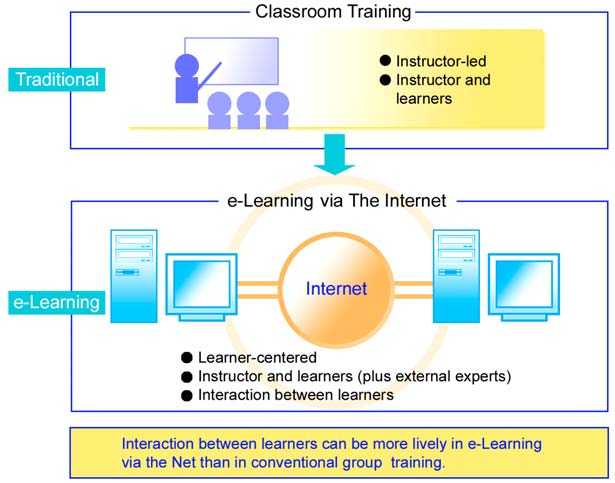
Ä E-learning online communication:

Communication Skills

Communication is the progression of transmission of information of an originator to a receiver by means of the use of a message that it goes from one to another across a channel.
Ä One-to-one communication:
Ø  Understand the importance of one-one communication
Ø  Select the most appropriate method to communicate
Ø  Prepare to communicate with an individual
Ø  Communicate appropriate and effectively
Ø  Maintain appropriate records of communications
Ä  Non-verbal communication:
Ø  Understand the need for the communication
Ø  Select written communication type
Ø  Produce effective written communication
Ø  Use standard conventions when writing
Ø  Use appropriate tone (eg: DON’T USE CAPITAL LETTER) and level of language.
Ä Effective communication
Ø  Understand the communication process
Ø  Appreciate the strengths and weaknesses of different methods of communication
Ø  Recognize which communication method to use in a range of work situation
Ø  Describe the key stages in the communications process


HOW TO BE AN EFFECTIVE TEAM PLAYER IN ONLINE FORUMS
 Leadership ability refers to competence in areas such as:

Qualities of an Effective Team Player :

  Qualities of group members:

  Internet forum guidelines for etiquette:


Thursday, 12 April 2012


USING THE INTERNET NET COMPETENCY


THE DO’S AND DON’TS OF USING THE INTERNET
Do:
Use the Internet to help in education.
Internet is the most important nowadays. Internet is a source of tons of information. It is because internet just like largest library in the world.
Beware with the personal information.
Posting private and personal information in the wrong location can have serious consequences.
Respect the privacy of other users.
Respecting others' privacy and not doing anything while online that will annoy or frustrate other people.
Watch out when copy or download programs from the Internet.
Use a virus scan program before loading them on your computer. Some programs may contain viruses that can harm the computer.

Don't:


Do not capitalize everything
It looks as if you are shouting at people.
Don't give password to anyone.
Posting private and personal information in the wrong location can have serious consequences.
Don't make copies of any copyrighted material,
Do not make any copies of books, magazines or music without the permission of the author, publisher or artist because any copyright works on the internet usually illegally and it is a crime if you are copy or distribute them.   


Obey Copyright Laws- Don’t steal!
Be Aware of Cyber bullying- Parents should talk honestly and openly to children about the issues of electronic bullying. Studies suggest most children do NOT tell a trusted adult if they are a victim of electronic bullying. If targeted by a cyber bully, do NOT respond.

Password management:


Core netiquette rules
Spell check and check over all written internet communication because errors diminish the credibility of the message.
Do not write in all capital letters because all caps are considered shouting when written on the internet.
Do not flame or respond to flames because personal insults are rough and netiquette is polite.
Do not spam or follow pop-up and spam links because they can lead to viruses, spyware, and malware.
Be conservative in email you send and liberal in email you receive because quality is better than quantity.
Do not send email at night because normal people sleep at night. Late night email may call your lifestyle into question.
Use discretion when sharing information online for personal and professional privacy reasons.

     INTERNET SECURITY
The openness of the internet has dramatically change global communication and making it possible for people around the world to easily exchange information at the same times, someone also generate a huge problem.
Everybody can excess the internet, but not everyone has good intentions. For example in malicious damage by malicious software program success, while others view hacking computer networks as a hobby.
To avoid becoming a victim of misguided pranksters or cybercrime, take time to check the security of your personal data.
Besides that, it is involving the protection of computer files and internet account from the unknown user to attack. For instance:
J    Choose good password protection
J    Change permission of files and computer data back.


Wednesday, 28 March 2012


INTRODUCTION TO AN ONLINE  TERTIARY SECTOR


HISTORY OF E-LEARNING

E-learning strategies have been introduced into public universities since 1996.
The 1990s were a period of considerable economic and educational change in Malaysia.
1990s = Prime Minister Datuk Seri Dr. Mahathir bin Mohamad introduced Vision 2020.
1996 = Establishment of the Multimedia Super Corridor and the privatization of tertiary education.
All these initiatives were interconnected. The Malaysian educational sector appears to have been revolutionized during the decade beginning in 1996.
Since then, E-learning is introduced widely and is encouraged to be implemented in organizations and education.


DEFINITION AND SCOPE OF E-LEARNING

As the letter “e” in e-learning stands for the word “electronic”, e-learning would incorporate all educational activities that are carried out by individuals or groups working online or offline.

E-learning is generally referred to the intentional use of networked information and communications technology in teaching and learning.

There are many of terms that always used to describe this mode of teaching and learning which are online learning, virtual learning, distributed learning, network and web- based learning.


E-Learning is a learning process that is facilitated and enhanced by using digital tools such as CD-ROMs, video conferencing, websites and e-mail where the content and instruction is delivered electronically. There are the examples of e-learning that has been practice: